Collection I:
Fall In Love
The inaugural collection.
Dive into a world of luxurious vintage and antique fashions, curated to whisk you from hot summer days into a warm, inviting autumnal collection of burnt ambers, pools of liquid silk, deep burgundies, antique gold, and warm taupe. With an eye on the season for love, find elegant silk satin wedding dresses and gowns from the 1920s-1930s.
A collection focused on the Edwardian period and 1930s-40s for the fashion icon ready to fall in love with fall.

Step into the elegance of the 1930s with this authentic vintage wedding gown, an exquisite piece that radiates glamour, grace, and the quiet romance of a bygone era. Crafted in sumptuous ivory satin with delicate lace detailing, this gown embodies the refined femininity of the decade, evoking silver screen sirens and candlelit ceremonies. With its fluid silhouette and dramatic train, it’s a stunning choice for the bride seeking both history and drama.
Features:
Genuine 1930s vintage bridal gown
Soft ivory satin with a beautiful natural sheen
Long lace sleeves with scalloped cuffs
Lace bodice with satin underlay and covered button back closure
Bias-cut satin skirt for graceful movement
Extra-long sweeping train for romantic drama
Attached belt with pearls at the buckle
Measurements:
Bust: 36-37 inches
Waist: 28 inches
Belt: 27 inches
Hips: 36+ inches (flexible sizing due to bias cut)
Sleeve length: 24.5 inches
Dress length, front: 58.5 inches
Dress length, back: 102.5 inches (44 inch train)
Fit: S/M
Notes:
Side snap closures at waist
This gown is in excellent near mint condition. The belt buckle is missing some pearls, and I have sourced vintage replacements.
A Brief History of 1930s Dresses:
Dresses from the 1930s are renowned for their elegance, fluidity, and romantic restraint — a marked shift from the exuberance of the 1920s. In the wake of the Great Depression, fashion embraced a more refined and feminine aesthetic, with an emphasis on grace, modesty, and luxurious simplicity. The bias cut — pioneered by designers like Madeleine Vionnet — became a defining feature of the decade. This technique allowed fabric, especially silk or satin, to drape and cling to the body in soft, flattering lines, enhancing natural curves without excess structure. Gowns of this era often featured long sleeves, high necklines, and low backs, achieving a balance between modesty and allure.
Lace became a popular detail, adding delicate texture to bodices, sleeves, and trims. Wedding dresses in particular embodied this understated glamour, often made from rayon satin or silk charmeuse, with subtle embellishments like covered buttons, gathered waists, or gently flared skirts. 1930s fashion was deeply influenced by Hollywood’s Golden Age, with stars like Jean Harlow and Carole Lombard embodying the era’s signature look: sleek, luminous gowns that glided across the floor and shimmered under soft lighting. Even in times of economic hardship, the 1930s dress offered a sense of fantasy — timeless, romantic, and endlessly graceful.

Step into timeless elegance with this breathtaking 1940s satin wedding gown. Crafted from luminous ivory satin, this gown radiates the understated glamour and romantic silhouette of wartime-era bridal fashion. The luxurious fabric cascades into a dramatic, sweeping train, while the tailored bodice, gathered waist, and long sleeves highlight the graceful beauty of 1940s design. A true heirloom piece, perfect for a vintage-inspired wedding or an exceptional collector’s display.
Side note: This was the model’s favorite wedding dress of the whole collection!
Features:
Authentic 1940s construction and detailing
Lustrous thick ivory satin with a dramatic full train
Elegant ruched bodice with flattering gathers
Long, fitted sleeves with a sculptural silhouette
Modest jewel neckline with delicate embellishments
Button closures down the back of the gown for a seamless fit
A romantic piece of fashion history
Garment Measurements:
Bust: 31 inches (note there is more room in the actual bust, the model measures 34 inches around the bustline)
Waist: 26 inches
Hips: Free
Sleeve length: 24 inches
Dress length, front: 57.5 inches
Dress length, back: 103.5 inches (a 46 inch train, nearly 4 ft long)
Notes:
Very excellent vintage condition, the gown has some wear in the mesh area, though not very noticeable.
This gown will arrive steamed.
A Short History of Post-War Wedding Gowns:
After World War II, wedding gowns with long, flowing trains made a striking comeback as part of a broader return to opulence and tradition. With fabric rationing lifted, designers embraced luxurious materials like satin, lace, and tulle, crafting gowns that celebrated femininity and grandeur. Influenced by royal weddings and Hollywood glamour, these postwar dresses often featured fitted bodices, full skirts, and cathedral-length trains, symbolizing hope, romance, and a new era of prosperity.

The silk is so soft and pours like liquid over the body. Step into the elegance of a bygone era with this extraordinary wedding gown—an authentic piece of bridal history. This wedding gown dates from the late 1920s to early 1930s. Made from sumptuous ivory silk, this gown glides over the figure with a fluid drape, showcasing the era's signature bias cut. The silhouette is both romantic and statuesque, featuring a ruched bodice, elegant long sleeves, and a sash at the waistline, which I have styled here as a rear peplum detail using art deco dress clips. It cascades into a graceful, short train. Every element evokes vintage candlelit glamour. A breathtaking heirloom gown for a bride with timeless style.
Features:
Authentic 1930s vintage wedding gown
Luminous ivory silk with beautiful drape and sheen — the fabric feels like silk air
Bias-cut for a figure-skimming silhouette
Sash at the waist that can be pinned as shown (or tied)
Long fitted sleeves with fabric-covered buttons at the cuffs
A subtle V-neckline
Side snaps closure
Garment Measurements:
Bust: 32 inches
Waist: 28 inches
Hips: 33 inches
Sleeve length: 26 inches
Dress length, front: 57.5 inches
Dress length, back: 74.5 inches (a 17 inch train)
Notes:
The 1930s vintage dress clips shown at the rear are a styling suggestion and do not come with the dress, but please message if you would like to include them for a small additional fee
This gown is in very good vintage condition, it does have slight unevenness in the silk coloring but it is noted upon very close inspection
This gown has been cleaned and will come to you steamed
History of 1930s Wedding Gowns:
The 1930s marked a pivotal era in bridal fashion, defined by elegance, fluidity, and the influence of Hollywood glamour. In the wake of the Great Depression, wedding gowns became more understated and practical, yet they remained deeply romantic and refined. The luxurious extravagance of the 1920s gave way to a more body-conscious silhouette, made possible by the revolutionary bias cut technique, popularized by French designer Madeleine Vionnet. This method allowed fabric—often silk or satin—to cling and flow naturally along the body, creating a graceful, sculpted look.
Sleeves were often long and slim or slightly puffed at the shoulders, while necklines ranged from modest V-shapes to cowl drapes. Many gowns featured elegant trains, fabric-covered buttons, and lace or satin accents, combining soft femininity with structured detail. Though times were tough economically, women still dreamed of beauty on their wedding day, and gowns from this decade reflect that balance between restraint and romance. These dresses remain beloved today for their timeless sophistication and ethereal quality and are especially in fashion today.

Radiating vintage grandeur, this authentic late 1930s to early 1940s wedding gown is a vision of timeless elegance. Crafted from luscious ivory satin with exquisite lace detailing, the silhouette blends soft Hollywood glamour with romantic Edwardian revival influence. With its sculptural puffed sleeves, defined waist, and dramatic nearly 4-foot train, this gown is made for a bride seeking a look that is both ethereal and iconic. Perfect for a vintage-inspired wedding or heirloom collection.
Features:
Authentic 1930s–40s vintage wedding gown
Glossy ivory satin with soft, flowing drape
Puff sleeves with ruching and lace panels for dramatic structure
Romantic V-neckline trimmed in antique lace
Wide sheer ecru lace waistband enhances and defines the figure
Elegant A-line skirt with a graceful train
Buttons up and down the back
Suitable for formal bridal wear, period styling, or collectors
Garment Measurements:
Bust: 34 inches
Waist: 28 inches
Hips: Free
Sleeve length: 24.5 inches
Dress length, front: 55 inches
Dress length, back: 97 inches (a 42 inch train, nearly 4 ft)
Fit: S/M
Notes:
This gorgeous wedding dress had some breakage in the lace panels, which have all been repaired. It is in excellent vintage condition
This wedding dress will come to you steam pressed
A Short History of Late 1930s to Early 1940s Wedding Dresses:
Wedding dresses from the late 1930s to early 1940s represent a fascinating transition in fashion—bridging the glamorous elegance of the pre-war era with the practical necessities of wartime. As the 1930s drew to a close, bridal fashion maintained its signature romance: bias-cut gowns, soft satin or silk fabrics, and delicate lace details. Gowns continued to drape closely to the body, with long sleeves, gathered busts, and fitted waists defining the silhouette. The influence of Hollywood still loomed large, inspiring graceful lines and dramatic trains reminiscent of silver screen icons.
However, by the early 1940s, World War II dramatically reshaped the landscape of bridal wear. Brides embraced structured shoulders, peplum waists, and covered buttons—details that reflected both the resilience and refined femininity of the era.

Step into poetic elegance with this authentic 1940s vintage jacket—a captivating blend of East and West. Crafted in soft peach-toned satin, this piece features a delicate print of swallows carrying love notes, a romantic motif that evokes timeless storytelling. With a Mandarin collar, elegant frog closures, and decorative tassels, the silhouette is both structured and fluid—perfect for layering over a velvet gown or pairing with modern separates for a striking contrast. This jacket is not just a garment; it's a wearable work of art.
Features:
Authentic 1940s vintage
Rare East-meets-West design
Swallow and love-note motif in intricate satin jacquard
Mandarin collar with decorative frog closures
Soft tassel ties at neckline
Lightweight, flowing structure
Beautifully preserved condition for its age
Garment Measurements:
Bust: 42-44 inches
Sleeve length: 22.75 inches
Length (shoulder to hem): 28 inches
Fit: S/M/L/XL
Notes:
Mint vintage condition with no flaws to note
A Short History on East-Meets-West Vintage 1940s Fashion:
In the 1940s, garments made in the East began incorporating Western design elements as global exchange intensified during and after World War II. Tailors and textile artisans in countries like China, Japan, and Hong Kong adapted their traditional silhouettes and techniques to suit Western tastes, creating hybrid garments for export and for Western clients stationed or traveling in Asia.
These garments often combined rich Eastern fabrics like silk brocade or embroidered satin with Western shapes such as tailored jackets, blouses, and eveningwear. Common features included Mandarin collars, frog closures, and traditional motifs (like cranes, dragons, or florals), applied to Westernized silhouettes. This cross-cultural fashion trend reflected both postwar global mobility and a growing Western fascination with East Asian aesthetics. Today, these garments are cherished for their craftsmanship, unique design fusion, and historical significance as wearable symbols of cultural dialogue.

Step back in time with this stunning, one-of-a-kind cropped jacket from the 1930s. Crafted from sumptuous cream rayon fringe, this piece exudes the elegance and exuberance of the Art Deco era. Every detail speaks to the craftsmanship and flair of vintage glamour—from its sculpted shoulders to the graceful movement of the fringe. Whether paired with high-waisted trousers or draped over an evening dress, this jacket is a showstopper and a rare collector’s piece for vintage lovers and fashion connoisseurs alike.
Features:
Authentic 1930s vintage garment
Luxurious cream rayon fringe in horizontal tiered rows
Cropped silhouette with strong shoulder structure
Short sleeves for a breezy, elegant finish
Hook-and-eye front closure (hidden when worn)
Fully lined for comfort and structure
Perfect for evening wear, vintage events, or collectors
Garment Measurements:
Bust: 31 inches (though as you can see, it presents well on a model with larger measurements)
Sleeve length: 9.75 inches
Shoulders: 15 inches
Length (from shoulders to hem): 18.5 inches
Fit: XS/S/M
Notes:
This garment is in excellent near mint condition
This has been cleaned and steamed and is ready to wear.
A Short History of 1920s–30s Fringe Clothing:
Fringe rose to fashion fame in the 1920s, becoming a symbol of rebellion and movement during the flapper era. Worn on straight-cut dresses, fringe accentuated dance and freedom, making it a hallmark of the Jazz Age. In the 1930s, fringe evolved into a more elegant and stylized detail, often used in rayon or silk on bias-cut gowns and evening jackets. Inspired by Hollywood glamour, it added fluidity and sophistication to eveningwear. Across both decades, fringe captured the spirit of modernity—first as bold and playful, then as refined and luxurious.

This is a fascinating and interesting hand crocheted lace tunic style overlay in a lovely dove grey / blue/ lavender pastel tone.
A rare and breathtaking example of early 20th-century craftsmanship, this original Edwardian lace tunic dress is a living piece of history. Dating from the 1900s to 1910s, it embodies the romantic femininity and artisanal detail that defined the era. Made entirely from fine cotton lace with intricate handwork, this garment was likely worn as a tunic or over-dress — a luxurious layer meant to elevate a woman’s silhouette with elegance and lightness.
Its design features the hallmarks of Edwardian style: a high lace neckline, fluttering sleeves, and a delicately draped fit that floats gently over the body. The asymmetrical hem, with its bold floral openwork lace, adds a touch of whimsy that remains striking even over a century later. Whether displayed as a collectible or worn as a statement of antique fashion, this tunic dress offers timeless grace.
This was likely layered over a beautiful full length white cotton walking skirt. Today, it can be worn simply as a dress, over pants, or as historically intended over a long skirt.
This is more than a garment — it’s a wearable heirloom. Perfect for collectors, historical costumers, vintage bridal styling, or those who simply cherish the beauty of true antique fashion.
Features:
Authentic antique piece from the Edwardian era (c. 1900s–1910s)
Asymmetrical hem, bodice, and waist
Deco style geometric inserts
Armholes are open to the waist.
Single snap at left side
Garment Measurements:
Bust (measured flat, from pit to pit): somewhat open due to cut of armholes, measures 18 inches across
Waist: 31 inches
Hips: approx. 36-39 inches
Bodice length: 15 inches
Skirt length: 18-31 inches
Fit: S/M/L
Notes:
Some stretch/give to measurements due to crochet construction
Excellent condition, very sturdy and wearable with no major flaws to note
Left side seams have been stitched up in a slightly darker colored thread though not distracting, it could be easily removed and redone if desired
Freshly laundered
The history of Irish crochet lace: a legacy of resilience and beauty
Irish crochet lace, a distinctive and highly valued textile art form, emerged from a poignant chapter in Irish history and continues to hold significant cultural and artistic value today.
A lifeline during the Great Famine
The mid-19th century witnessed the devastation of the Great Irish Famine (1845-1849), when widespread potato crop failure led to starvation and mass emigration. In this desperate time, Irish crochet lace became a lifeline, providing a much-needed source of income for impoverished families.
Inspired by Venetian Lace: The techniques of Irish crochet were developed to mimic the intricate beauty of expensive Venetian point lace, making it a desirable alternative for the upper classes.
Teaching and Enterprise: Nuns in convents and relief schools, established in part due to famine relief efforts, taught the craft to women and girls across the country. These schools and stores not only provided education but also served as outlets for selling the handmade lace.
Cottage Industry: This fostered a thriving cottage industry where families and communities specialized in creating individual motifs – flowers, leaves, and other designs – which were then assembled into larger pieces like collars, cuffs, and dresses.
Why Irish crochet is valued today
Irish crochet's value today extends beyond its historical significance, encompassing its inherent artistry, cultural importance, and growing appeal in the modern craft and fashion worlds.
Intricate Beauty and Craftsmanship: Irish crochet is renowned for its delicate and intricate designs, including motifs like flowers, shamrocks, and grapevines. The use of padded cords and various stitches creates a unique three-dimensional texture, showcasing the skill and dedication of the lacemaker.
Connection to the Maker and Storytelling: Irish crochet is a tangible link to Ireland's past, particularly the resilience and resourcefulness of the Irish people during challenging times. Each piece of Irish crochet tells a story – a story of skill, dedication, and the history embedded in its creation. This personal connection to the maker and the narrative behind the craft contributes to its intrinsic value.

Step into timeless elegance with this breathtaking hand-crocheted lace dress from the 1920s-30s. A true testament to craftsmanship and romantic design, this piece exudes delicate femininity with every stitch. The intricate floral crochet motif on the bodice blends seamlessly into a diamond mesh body, creating a graceful silhouette that softly skims the figure. Whether worn for a garden party, vintage-inspired wedding, or cherished as a collector's piece, this dress is a rare and radiant find from a bygone era.
Features:
Authentic 1930s vintage, meticulously hand-crocheted
Cap sleeves and scalloped neckline with floral lace motifs
Fitted elastic waist with subtle shaping for a flattering fit
Mesh skirt with floral lace hem detailing
Soft ivory color, perfect for layering over slips or undergarments
Elegant mid-calf length with a light and airy drape
Floral detail at collar
Garment Measurements:
Bust: 36 inches
Waist: 28-29 inches
Shoulders: 15.5 inches
Sleeve length: 4 inches
Length, shoulder to waist: 15 inches
Length, waist to hem: 37.5 inches
Total length: 52.5 inches
Notes:
This dress is hand-knit and will accommodate a variety of sizes (see measurements above).
This garment is in excellent nearly mint condition with no issues to note
A Short History of 1930s Crochet Dresses:
In the 1930s, crochet dresses became popular as stylish, handmade alternatives during the Great Depression. Women crafted them at home using patterns from magazines, combining economy with elegance. Typically made of cotton thread, these dresses featured floral motifs, mesh panels, and scalloped hems. Fitted waists and mid-length silhouettes reflected the streamlined fashion of the era, making crochet dresses both practical and feminine.

A breathtaking example of Edwardian-era artistry, this authentic antique Irish crochet blouse is a rare and intricate work of wearable history. Handcrafted in the early 1900s, it showcases the technical brilliance and romantic beauty of traditional Irish lacework. With its sculptural florals, delicate meshwork, and a regal high neckline, this piece evokes the refined elegance of a bygone world.
Whether worn as a statement blouse or treasured as a collector’s piece, this heirloom garment commands admiration for its craftsmanship, texture, and quiet luxury. Because of the construction, this can be worn as a classic high necked Victorian/Edwardian bodice blouse as historically intended, or turned around and worn as a fabulous cropped jacket.....two tops in one! Add a simple white skirt., or pair with jeans and a tank.
Features:
3/4 length sleeves
Fastens with tiny snaps
Genuine antique Irish crochet, handcrafted circa 1900s
Lavish floral and botanical motifs layered over delicate open mesh
High Victorian collar with scalloped edge
Shaped waist and elegant drape for a softly structured silhouette
Full-length sleeves with intricate flared lace cuffs
Natural ivory tone, beautifully aged with time
Museum-quality construction suitable for collectors, historians, or bridal heirlooms
Garment Measurements:
Bust and waist: up to 35 inches
Sleeve length: 16 inches
Length (shoulder to hem): 18 inches
Shoulder to shoulder at back: 17 inches
Fit: S/M
Notes:
Garment is clean and ready for wear/admiration
No notable or obvious breaks in the lace, excellent almost mint antique vintage condition
A History of Irish crochet lace: a legacy of resilience and beauty
Irish crochet lace, a distinctive and highly valued textile art form, emerged from a poignant chapter in Irish history and continues to hold significant cultural and artistic value today.
A lifeline during the Great Famine
The mid-19th century witnessed the devastation of the Great Irish Famine (1845-1849), when widespread potato crop failure led to starvation and mass emigration. In this desperate time, Irish crochet lace became a lifeline, providing a much-needed source of income for impoverished families.
Inspired by Venetian Lace: The techniques of Irish crochet were developed to mimic the intricate beauty of expensive Venetian point lace, making it a desirable alternative for the upper classes.
Teaching and Enterprise: Nuns in convents and relief schools, established in part due to famine relief efforts, taught the craft to women and girls across the country. These schools and stores not only provided education but also served as outlets for selling the handmade lace.
Cottage Industry: This fostered a thriving cottage industry where families and communities specialized in creating individual motifs – flowers, leaves, and other designs – which were then assembled into larger pieces like collars, cuffs, and dresses.
Why Irish crochet is valued today
Irish crochet's value today extends beyond its historical significance, encompassing its inherent artistry, cultural importance, and growing appeal in the modern craft and fashion worlds.
Intricate Beauty and Craftsmanship: Irish crochet is renowned for its delicate and intricate designs, including motifs like flowers, shamrocks, and grapevines. The use of padded cords and various stitches creates a unique three-dimensional texture, showcasing the skill and dedication of the lacemaker.
Connection to the Maker and Storytelling: Irish crochet is a tangible link to Ireland's past, particularly the resilience and resourcefulness of the Irish people during challenging times. Each piece of Irish crochet tells a story – a story of skill, dedication, and the history embedded in its creation. This personal connection to the maker and the narrative behind the craft contributes to its intrinsic value.

This striking 1940s authentic rayon jersey dress channels the bold elegance of iconic mid-century American design, drawing clear inspiration from Gilbert Adrian’s legendary “Firebird” dress. With its sweeping, colorful feather-like print on a cream background, sculptural silhouette, and subtle keyhole neckline, this piece evokes the same theatrical glamour that made Adrian a fashion legend. The dress hugs and moves with the body, thanks to its luxuriously soft rayon jersey fabric—making it as comfortable as it is breathtaking. A rare, museum-worthy garment for collectors and serious vintage lovers alike.
This gown also features a long attached sash at the neckline that can be worn hanging down as photographed. It can also be worn as a hood or around the neck.
Features:
Fabric: Rayon jersey with beautiful drape and stretch
Print: All-over feather/flame motif in vivid hues of orange, maroon, green, and yellow on a soft cream ground
Design details: High gathered neckline with keyhole cutout; cap sleeves and flattering side-ruching for a sculpted silhouette; and a slim, elongated shape reminiscent of Adrian’s signature draping
Inspiration: Echoes the drama and color play of Adrian’s famed “Firebird” dress (c. 1940s)
Garment Measurements:
Bust: 30-38 inches
Waist: 26-33 inches
Hips: 36-42 inches
Dress length (shoulder to hem): 54 inches
Notes:
This dress is in mint vintage condition and is ready to wear
History: 1940s Rayon Jersey Fashion
In the 1940s, rayon jersey became a revolutionary fabric in women’s fashion, prized for its comfort, fluidity, and adaptability during a time when practicality and style had to coexist. Rayon jersey's soft, clinging quality made it ideal for the era’s elegant, figure-flattering drapes. Designers used gathers, ruching, and wraps to enhance the female form without restricting movement. Dresses made from rayon jersey could easily transition from daywear to eveningwear, with understated prints or darker solids for daytime and more dramatic shapes or embellishments for evening. Stars like Rita Hayworth and Lauren Bacall popularized the slinky, curve-skimming jersey look, bringing Old Hollywood sophistication into everyday wardrobes. Despite fabric limitations, 1940s women’s fashion retained a strong sense of polish. Rayon jersey provided a wash-and-wear solution that was durable yet graceful—perfect for working women, housewives, and socialites alike. In short, rayon jersey fashion of the 1940s captured the spirit of resilience and refinement, offering women a way to feel both comfortable and elegant during a decade of profound social change.

This captivating 1940s rayon jersey dress is a true gem of mid-century fashion. With its rich, swirling floral print and flattering draped silhouette, it strikes the perfect balance between bold elegance and easy wearability. The supple rayon jersey fabric molds gently to the body, offering both comfort and glamour. Finished with a gathered hip and a vivid red belt for a cinched waist, this piece channels timeless femininity with an artful edge — ideal for vintage lovers or collectors of era-defining fashion.
Features:
Distinctive feature: A beautiful panel that is draped in three loops and adorned with gorgeous iridescent sequins
Material: Soft and stretchy rayon jersey
Print: Dramatic floral pattern in warm tones of rust, cream, and taupe on a deep brown background
Silhouette: V-neckline with gathered hip detailing and draped skirt
Sleeves: Short sleeves with subtle puff at the shoulder
Garment Measurements:
Bust: 36-42 inches
Waist: 31-34 inches
Hips: 36-40 inches
Sleeve length: 7.75 inches
Dress length: 45.5 inches
Fit: M/L/XL
Notes:
The belt is a styling suggestion and not included in this sale
This garment has been gently cleaned and is ready to wear
There are some small areas where some general discoloration is noted upon very close inspection but is not notable when worn, it is in excellent vintage condition
History: 1940s Rayon Jersey Fashion
In the 1940s, rayon jersey became a revolutionary fabric in women’s fashion, prized for its comfort, fluidity, and adaptability during a time when practicality and style had to coexist. Rayon jersey's soft, clinging quality made it ideal for the era’s elegant, figure-flattering drapes. Designers used gathers, ruching, and wraps to enhance the female form without restricting movement. Dresses made from rayon jersey could easily transition from daywear to eveningwear, with understated prints or darker solids for daytime and more dramatic shapes or embellishments for evening. Stars like Rita Hayworth and Lauren Bacall popularized the slinky, curve-skimming jersey look, bringing Old Hollywood sophistication into everyday wardrobes. Despite fabric limitations, 1940s women’s fashion retained a strong sense of polish. Rayon jersey provided a wash-and-wear solution that was durable yet graceful—perfect for working women, housewives, and socialites alike. In short, rayon jersey fashion of the 1940s captured the spirit of resilience and refinement, offering women a way to feel both comfortable and elegant during a decade of profound social change.

An outfit worthy of Old Hollywood powerhouse starlets like Ava Gardner, step into mid-century elegance with this show-stopping 1940s copper-toned beaded evening ensemble. Designed to dazzle, the fitted silhouette and intricate micro-beading reflect the era’s emphasis on sophisticated femininity and meticulous craftsmanship. The cropped jacket adds structured glamour, highlighted with removeable gold winged dress clip embellishments at the neckline that echo wartime style motifs. Whether worn as a full set or styled separately, this ensemble exudes refined vintage allure with a dramatic Art Deco touch.
Features:
Authentic 1940s vintage two-piece ensemble
Warm copper base fabric with allover micro-sequined beading in swirling patterns
Cropped bolero jacket with pointed hem and shoulder embellishments
Sleeveless underdress with gathered sweetheart neckline and curve-skimming fit
Bolero is fully lined for comfort and features strong dramatic padded shoulders
Zips up the back with a metal zipper
Mid-calf length perfect for evening elegance
Dress Measurements:
Bust: 35-36 inches
Waist: 27-28 inches
Hips: up to 42 inches
Bodice length: 9 inches
Dress length: 40 inches
Bolero Measurements:
Shoulders: 16 inches
Sleeve length: 24 inches
Length (shoulder to hem): 14 inches
Notes:
This vintage ensemble is in good vintage condition. It has some fading from sunlight which has been repaired through dying. Some slight color variation remains visible on the top of the strapless dress, though it is not visible when the bolero is worn. There is one area on the bolero with a breakage in the fabric and another on the inside that is not visible when worn.
It was missing some beads for which I have sourced antique replacements and repaired.
A Brief History of 1940s Women's Fashion:
The 1940s marked a transformative decade for women’s fashion, shaped by the austerity of World War II and the elegance of post-war glamour. Early in the decade, clothing was heavily influenced by wartime restrictions—fabrics were rationed, leading to practical, streamlined silhouettes with minimal embellishment. Utility wear dominated, featuring tailored suits, padded shoulders, nipped waists, and knee-length skirts designed for functionality and movement.
As the war ended, fashion shifted dramatically. With the return of peace and prosperity, women’s clothing embraced a renewed sense of femininity and luxury. Eveningwear, in particular, reflected this change: silhouettes became more fitted and hourglass-shaped, and garments featured rich fabrics, elaborate beading, and ornate details. Designers like Christian Dior led this shift with his 1947 "New Look," emphasizing small waists, full skirts, and romantic styling.
The ensemble shown here—a beaded, form-fitting dress with a cropped jacket—exemplifies late 1940s glamour. It captures the era’s transition from wartime practicality to the ornate and sophisticated styles that would define postwar fashion for years to come.

Step into the golden age of glamour in this show-stopping vintage velvet gown by Kalmour, a designer known for luxurious eveningwear in the 1930s–40s. Crafted in a sumptuous rust-colored silk velvet, this dress captures Old Hollywood elegance with every curve and movement. The sculptural pleating at the shoulders and bust adds dimensional richness, while the deep V-back introduces a dramatic silhouette that’s as seductive as it is sophisticated.
Designed to glide with grace, this gown is pure vintage romance — perfect for collectors, special occasions, or museum-worthy moments.
Features:
Label: Original Kalmour registered with FOGA
Closes at the side with a long metal zipper
Rich copper velvet with a luminous silk-like sheen
Dramatic pleated shoulder detail with gathered ties
Flattering deep V neckline in front and plunging V back
Bias-cut velvet skirt for graceful, body-skimming movement
Defined waistline enhances hourglass silhouette
Side snap closures for a clean finish and period authenticity
Garment Measurements:
Bust: 44 inches, with give due to gathered fabric
Waist: 33 inches
Hips: 48 inches
Bodice length: 16 inches
Length (shoulder to hem): 51 inches
Fit: L/XL
Notes:
Beautiful excellent vintage condition — there is one repair done many long decades ago one side bodice but it is not detectable when worn and only seen upon close inspection
History of Kalmour:
Kalmour was well-known during the 1930s and 40s for its innovations in fabric, mainly with Celanese. Its designs were frequently featured in Vogue Magazine, with examples shown in the last listing photos here.

Step into the refined charm of the 1930s with this stunning hand-crocheted dress, a true testament to the artistry and elegance of early 20th-century fashion. Crafted in a warm russet hue, the intricate openwork creates a light, airy silhouette that drapes beautifully while highlighting its handmade quality. Romantic, breathable, and endlessly versatile, this dress brings together the relaxed ease of vintage resort wear with the enduring sophistication of Art Deco design. An incredibly rare and wearable piece of fashion history.
Features:
Authentic 1930s vintage hand-crocheted dress
Beautiful russet brown tone with exquisite open lacework
Short puff sleeves and scalloped edges for a romantic finish
Adjustable tie waist for a flattering, flexible fit
Slip-on style; ideal for layering with a slip or bodysuit
Midi-to-maxi length with soft flare at hem
Entirely handmade
Perfect for collectors, period styling, or romantic vintage wardrobes
Garment Measurements:
Bust: 36 inches
Waist: 30 inches
Hips: 39 inches
Sleeve length: 9 inches
Bodice length: 17 inches
Dress length (shoulder to hem): 48 inches
Fit: S/M/L
Notes:
This dress requires undergarments or a slip for wearing. The slip shown here is not sold with this listing.
This dress is in nearly mint condition, the only condition note is that the neckline at the back is missing its original button and has been replaced.
A Short History of 1930s Hand-Crochet Clothing:
In the 1930s, hand-crocheted clothing became both a practical craft and a fashionable statement, reflecting the era’s blend of economic hardship and creative ingenuity. Amid the Great Depression, many women turned to crochet as a cost-effective way to make stylish garments at home, often using patterns from magazines and repurposed yarns. Crochet designs of the 1930s featured refined, lace-like openwork, with elegant motifs and fitted silhouettes that aligned with the more feminine and body-conscious styles of the decade. Popular items included dresses, blouses, beachwear, and evening tops, often made in fine cotton or rayon thread for a lightweight, draping effect. Both practical and decorative, hand-crocheted clothing from this period showcased the skill and artistry of home makers and artisans alike—merging necessity with timeless beauty.
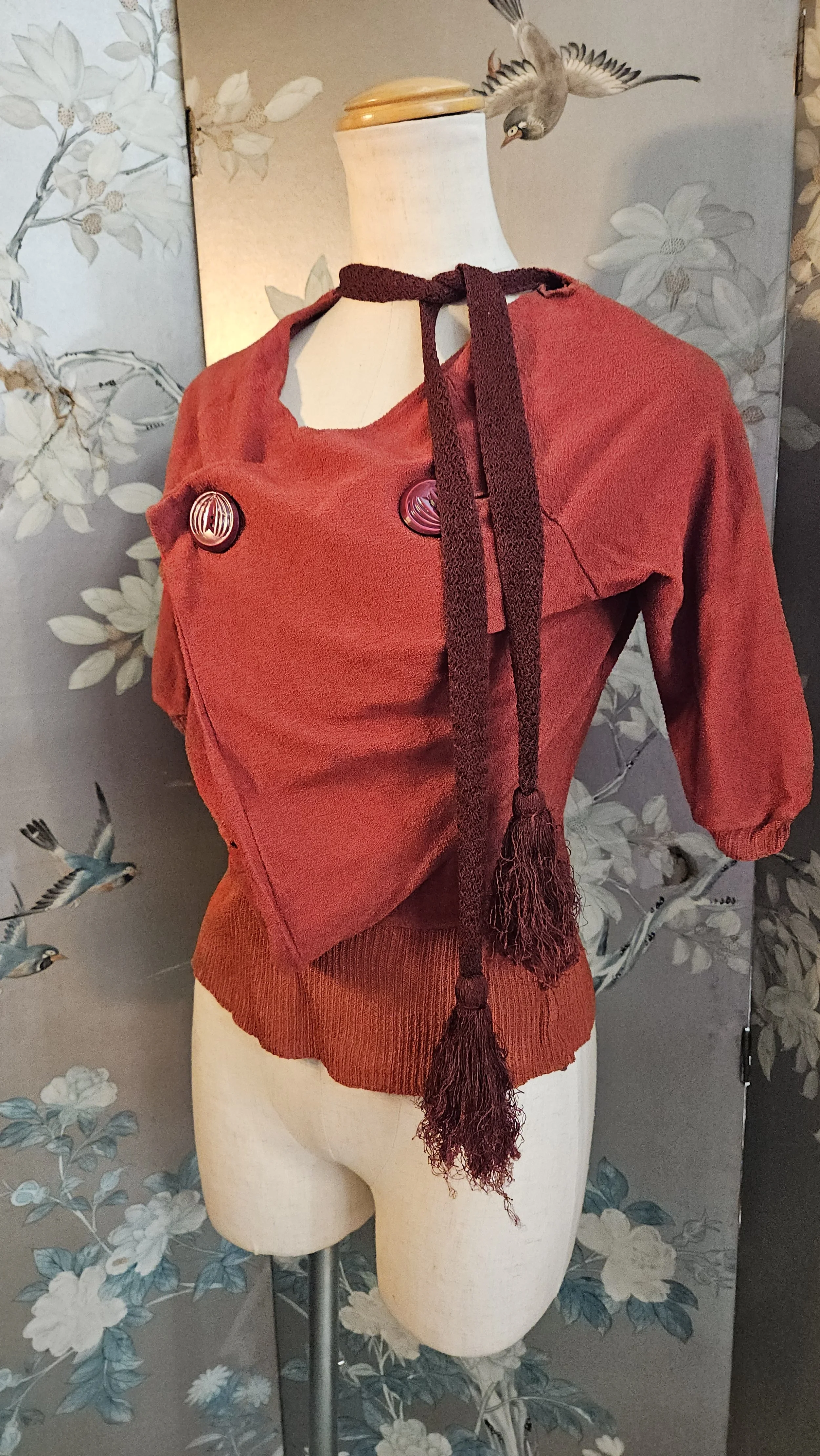
A striking example of 1920s fashion, this authentic vintage knit blouse captures the spirit of the Jazz Age with bold design and effortless elegance. Made from soft, rust-hued knit with a textured hand, the silhouette features distinctive Deco lines and a charming asymmetrical front flap adorned with large celluloid buttons. A deep wine-colored knit tie with original tassels drapes from the neckline—a playful nod to the era’s penchant for unexpected detail.
This piece would have likely been worn casually or for sporting occasions, yet today it carries a chic, almost avant-garde appeal. It’s rare to find 1920s knitwear in such wearable condition, making this both a collector’s gem and a statement garment for the modern wardrobe.
Features:
Authentic 1920s knit construction
Rust-red body with contrasting burgundy knit tie
Original tasseled necktie attached at collar
Dramatic Deco-inspired front flap
Two large celluloid buttons with spiral design
Cropped ribbed waistband and cuffs
Garment Measurements:
Bust (measured flat, from pit to pit): 36 inches
Waist (measured flat, from side to side): 26.5-27 inches
Sleeve length: 11.5 inches
Length (shoulder to hem): 20.5 inches
Fit: S
Notes:
Excellent vintage condition and ready to wear
This garment has limited stretch to its knit
A Short History of 1920s Knitwear:
The 1920s marked a revolutionary era in fashion—and knitwear played a vital role in that shift. As women embraced more active lifestyles and looser silhouettes, knit fabrics emerged as a stylish and practical alternative to the rigid tailoring of previous decades. Designers like Coco Chanel popularized jersey knits for everyday wear, bringing sportswear sensibilities into the mainstream. Machine-knitting advancements made knitwear more accessible, while artistic influences like Art Deco encouraged bold shapes, asymmetry, and creative detailing. Knit tops, sweaters, and even dresses were now fashion-forward garments rather than purely utilitarian. They reflected the new woman of the Jazz Age—modern, mobile, and unapologetically independent.

This breathtaking sheer silk blouse from the 1910s–1920s exudes the mystique and romance of the Jazz Age, embodying the elegance of Edwardian silhouettes with the exotic influence of Egyptomania that swept fashion in the 1920s. Crafted from whisper-thin silk chiffon and delicately hand-embroidered with stylized lotus flowers, the motif draws clear inspiration from Ancient Egyptian iconography—an homage to the era's "Tut-mania" sparked by the 1922 discovery of King Tutankhamun’s tomb. Perfectly suited for collectors or connoisseurs of wearable history, this blouse balances fragility with striking visual presence. Whether styled with a high-waisted skirt or layered under modern tailoring, this piece tells a story of cultural fascination and feminine allure.
Features:
Authentic 1910s–1920s antique piece
Fine silk chiffon in a rare khaki color with sheer long sleeves
Hand-embroidered Egyptian lotus motif on the bodice
Original inner lace panel
Softly draped sailor-style collar at the back
Elegant fit with subtle volume in the sleeve and shoulder
A rare and evocative example of early 20th-century Egyptomania in fashion
Garment Measurements:
Bust: 46 inches
Hemline: 37 inches
Sleeve length: 20.5 inches
Length (shoulder to hem): 18 inches
Notes:
One snap closure at the neck, one snap and hook and eye at one waistline
Includes an antique sizing tag at the back of the neck marked “44”.
Egyptomania Fashion: A Brief History
Following the 1922 discovery of King Tutankhamun’s tomb, the world was swept up in Egyptomania—a fascination with ancient Egypt that dramatically influenced 1920s style. Designers embraced Egyptian Revival motifs such as lotus flowers, scarabs, pyramids, and sun discs, integrating them into embroidery, prints, and accessories. Flapper silhouettes mirrored the straight lines of ancient tunics, while metallic fabrics and bold, geometric details evoked the opulence of pharaonic treasures. Eye makeup and jewelry also reflected Egyptian aesthetics, with kohl-lined eyes and beaded headpieces becoming fashionable statements. Today these garments represent a time of cultural discovery and this garment should be worn in historical and cultural appreciation of this.

Step into timeless elegance with this authentic vintage convertible skirt-pants, a rare treasure from a bygone era. Meticulously tailored and beautifully preserved, this garment is a statement in sophisticated craftsmanship and ingenious design. It effortlessly transforms from an elegant high-waisted skirt into wide-leg culottes with a clever side-button configuration, offering both drama and functionality. Ideal for collectors, stylists, or anyone who loves wearable history, this piece brings vintage couture into the modern day with striking effect.
Features:
Authentic vintage construction — likely late 1800s or early 1900-10s, exceptionally rare
Convertible design — transitions from long skirt to wide-leg culottes, however, the skirt panel does not detach like later styles do, hence the earlier circa dating
Double row of large buttons — functional and sculptural, running diagonally across the front
High waist cut — flatters the silhouette and elongates the leg
Rich, heavyweight wool or wool-blend fabric — structured yet fluid in movement
Expert tailoring — dramatic drape and crisp lines
Versatile styling — pairs beautifully with sheers, silks, or tailored separates
Garment Measurements:
Waist: 28 inches
Hips: 44+ inches
Inseam: 21 inches
Outseam: 38 inches
Notes:
Nearly mint condition, the only exception is one moth nibble at the back waistline.
History
Split skirts, also known as bifurcated skirts, were a late Victorian and Edwardian fashion innovation that allowed women more freedom of movement, particularly for activities like cycling. The split skirt was a step towards more practical and comfortable clothing for women, challenging the Victorian era's restrictive fashions. These skirts, designed with hidden trouser legs, aimed to provide the modesty of a skirt while offering the practicality of pants.

Step into the Edwardian era with this exquisite antique walking suit jacket, dating from the 1900s–1910s. Made of sturdy olive wool with intricate soutache embroidery, this piece is a remarkable example of early 20th-century tailoring. The silhouette flatters the figure with a nipped-in waist, gently puffed sleeves, and a longline hem, while the ornate embroidery adds elegance from every angle. Perfect for collectors, period reenactors, or anyone seeking a wearable piece of fashion history.
Features:
Authentic Edwardian walking jacket (c. 1900s–1910s)
Rich olive wool base with mauve soutache embroidery
Gently puffed shoulders and fitted sleeves with embroidered cuffs
Hook-eye-front closure with decorative accents
Tailored silhouette with paneled construction
Fully embroidered back with symmetrical scrollwork motifs
Lined interior with hand-finished seams
Garment Measurements:
Bust: 34-37 inches
Waist: 30 inches
Hips: 40-42 inches
Shoulders: 15.75 inches
Sleeve length: 25.5 inches
Length: 35 inches
Notes:
This garment is in beautiful very good vintage condition. It is mint with two exceptions: there are some moth nibbles here and there; and the neckline inside has some wear (and does not show when worn)
The hook and eye closures down the front fascinatingly alternate directions for security
Brief History of Edwardian Walking Jackets:
Edwardian walking jackets emerged in the early 1900s as practical yet stylish outerwear for women engaging in outdoor activities like promenading or shopping. Reflecting the era’s shift toward more active lifestyles, these jackets featured tailored silhouettes, structured shoulders, and elegant embellishments such as soutache embroidery or velvet trim. They often formed part of a walking suit, paired with a matching skirt, and embodied the graceful yet increasingly modern sensibilities of Edwardian fashion.

Step into the golden age of glamour with this exquisite 1940s vintage coat by Evalen. A stunning relic of refined style, this piece embodies the grace and craftsmanship of a bygone era. The coat’s soft drape, warm neutral hue, and intricately embroidered velvet trim radiate sophistication. Whether layered over a dress or styled with modern separates, this piece offers a rare fusion of history and elegance — perfect for collectors or vintage connoisseurs.
Features:
Label: Evalen Original New York; Established 1905 The Grand Milwaukee
Material: Smooth midweight fabric with detailed velvet embroidery
Color: Warm beige with rich aubergine velvet trim
Design: Open front with a single covered button closure at the bust
Sleeves: Elegant long sleeves with peek-through detail
Fit: Graceful drape with a flattering silhouette
Garment Measurements:
Bust: 44 inches
Length (shoulder to hem): 44 inches
Fit: S/M/L/XL
Notes:
Made of wool gabardine, this light-to-medium weighted caped coat does have some moth nips throughout. It is otherwise in excellent vintage condition.
History of Evalen:
Evalen Originals was a distinguished fashion label based in New York during the mid-20th century, renowned for its exceptional craftsmanship and elegant designs. Evalen Originals are sought after coats, capes, and suits. Well-known for its consistent use of gabardine, soutache, and beading Evalen designs are instantly recognizable. Specializing in women’s apparel, the brand was particularly noted for its use of high-quality materials and intricate detailing. Today, pieces from Evalen Originals are considered rare and highly collectible, reflecting the brand’s enduring legacy in the fashion world. Their creations continue to captivate vintage fashion enthusiasts and collectors alike, serving as a testament to the elegance and artistry of mid-20th-century American fashion.

Own a rare piece of history. Originally designed for adventurous women who demanded both function and modesty, these rare antique Duxbak split pants are a remarkable piece of outdoor wear history. Dating to the early 20th century, this garment is cleverly constructed with wide trouser legs concealed beneath a buttoned front panel, allowing it to transform from practical pants into the elegant illusion of a long skirt.
Made for hiking, horseback riding, or camping — yet styled to pass in polite society — this very highly collectable and wearable piece is in a RARE larger size and captures the spirit of pioneering women who balanced grit with grace. A true collector's item with a timeless silhouette, it's as striking now as it was then.
Features:
Label: Kamp-it Outing Clothing Ultra Duxbax Corporation
Authentic antique Duxbak garment, early 1900s
Wide-leg pants hidden beneath a full wrap panel – converts seamlessly from skirt to trousers
Heavy-duty cotton twill in a rich olive-drab hue, made for durability
Double-row button closures secures the skirt for tailored styling
Large utility pocket at the hip for function and charm
Versatile silhouette – historically worn for active pursuits, now perfect for statement styling
Beautiful movement and drape, ideal for photography, display, or wear
Garment Measurements:
Waist: 32 inches
Hips: 44+ inches
Inseam: 20.25 inches
Outseam: 35.25 inches
Fit: If worn at the waist, this is a very rare L, however as shown, it can be worn lower for S/M sizes
Notes:
Condition: Excellent vintage condition. This pant-skirt retains every single one of its original buttons and is ready for more adventures!
This garment has not been washed to retain its lived-in look many prefer with Edwardian clothing.
The History of the Duxbax Company
Before today’s popular outdoor brands like Patagonia and Columbia, Duxbak was a pioneer in functional outdoor apparel. Founded in January 1904 as the Utica-Duxbak Corporation in Utica, New York, the company emerged during a time when specialized outdoor wear barely existed. Men typically wore generic wool garments for outdoor sports, while women relied on cotton dresses or riding breeches—none of which were ideal for rugged conditions.
Recognizing the growing interest in wilderness recreation around the Adirondacks, Duxbak’s founders created durable, water-repellent clothing using duck cloth—a tightly woven canvas. Their innovation led to the brand name “Duxbaks,” a clever nod to how water rolled off their garments “like a duck’s back.”
The company rapidly gained popularity by advertising in adventure magazines and catering to both men and women. They later introduced lighter garments under the label “Kamp-It.” Duxbak clothing became widely recognized for its quality and utility, even worn by figures like President Theodore Roosevelt—whose Duxbak outfit now resides in the Smithsonian Museum.
By the 1920s, Duxbaks were a go-to choice for outdoor enthusiasts. Duxbak helped lay the foundation for modern outdoor fashion by blending functionality, innovation, and adventure-ready design.

This authentic vintage B. Altman blazer blends sharp city tailoring with country elegance, capturing the timeless sophistication of equestrian style. Likely dating to the mid-20th century, this blazer features a streamlined silhouette with a unique seat panel inside — a subtle nod to its likely original practical use on horseback.
Crafted in a rich, warm brown wool, the jacket’s minimalist design allows its fine construction and heritage charm to shine. Whether styled for modern wear or collected for its historical merit, this piece is a beautifully tailored tribute to refined sporting tradition.
Features:
Label: B. Altman & Co. Paris New York
Based on label comparisons from the Vintage Fashion Guild, this jacket dates approximately to the 1920s
Authentic vintage blazer from luxury retailer B. Altman & Co.
Wool construction in a deep, earthy brown
Tailored equestrian silhouette with a gently structured shoulder
Paneled seat detail suggests functional riding wear origins
Single-breasted design with sleek lapels and waist pockets
Fully lined interior for comfort and durability
Elegant, versatile fit — perfect layered over dresses, trousers, or riding-inspired looks
Garment Measurements:
Bust: 34 inches
Waist: 30 inches
Sleeve length: 22 inches
Length (shoulder to hem): 26.5 inches
Fit: S/M
Notes:
This blazer is in phenomenal vintage condition with no notes on condition. The sole exception is that the seat paneling inside has some wear, which does not affect its sturdiness, function, and does not show when worn.
The true color of this blazer is a rich, warm chocolate brown.
The History of the B. Altman & Company
B. Altman & Company was a prestigious American department store founded in 1865 by Benjamin Altman in New York City. Initially located on the Lower East Side, the store moved several times as it grew, eventually settling in its iconic Italian Renaissance-style flagship building at Fifth Avenue and 34th Street in 1906. It was the first major department store to relocate from the “Ladies’ Mile” to Fifth Avenue, influencing other retailers to follow suit.
Altman’s was known for its refined atmosphere and conservative elegance, offering upscale merchandise and genteel service. It also pioneered the opening of suburban branches, with locations in White Plains, Manhasset, Short Hills, and others.
After Benjamin Altman’s death in 1913, ownership of the store passed to the Altman Foundation. In 1986, shifting tax laws prompted the foundation to sell the store to an investor group. It was later acquired by Australian firm L.J. Hooker in 1987, whose misguided retail strategy led to the chain’s rapid decline. B. Altman filed for bankruptcy in 1989, and all stores were closed by early 1990.
The Fifth Avenue flagship was designated a New York City landmark in 1985 and later repurposed to house the CUNY Graduate Center and the NYPL’s Science, Industry and Business Library. The store's elegant legacy included beloved holiday windows and the Charleston Gardens restaurant. B. Altman remains part of American cultural memory, appearing in The Marvelous Mrs. Maisel television series.

Step into the warmth and charm of the 1930s with this authentic vintage cardigan—a perfect blend of classic pre-war style and cozy craftsmanship. This piece features a bold argyle pattern in deep burgundy, soft cream, and pale blue hues, evoking the sporty elegance popular during the decade. Pair it with a simple dress or high-waisted trousers for an effortlessly nostalgic look that’s as wearable today as it was nearly a century ago.
Features:
Authentic 1930s vintage homemade construction and styling
Rich burgundy wool knit with contrasting argyle pattern
Classic front button closure with original vintage buttons
Thick ribbed cuffs and hem for a structured, cozy fit
Perfect layering piece for autumn or winter ensembles
Measurements:
Bust: 40 inches
Sleeve length: 24.5 inches
Length (shoulder to hem): 24 inches
Fit: S/M/L/XL
Notes:
This appears to have been a lovingly handknit garment, in very good vintage condition, the sweater has some wear, most notably the bottom button is halved
This cozy sweater is ready for wear
The History of 1930s Home-Knitwear:
During the 1930s, home-knitting saw a significant resurgence as economic hardship from the Great Depression encouraged frugality and self-sufficiency. With ready-made garments often too costly, many women turned to knitting as both a practical necessity and a creative outlet. Magazines and pattern booklets flourished, offering stylish yet economical designs for sweaters, cardigans, vests, and accessories.
Knitting became a social and domestic activity, often taught from mother to daughter, and patterns began to reflect the sleek, tailored styles of the era—favoring slim silhouettes, puffed sleeves, and decorative stitches. Wool yarns in rich, earthy tones were common, and knitwear was often custom-fitted to the wearer’s body, lending each garment a uniquely personal touch. By the end of the decade, home-knit fashion had become both a statement of resilience and a testament to the skilled craftsmanship found in everyday households.

This exquisite 1940s vintage day dress is a quintessential example of French wartime elegance, sourced directly from Paris 15 years ago. Crafted from a fluid rayon-silk blend in a deep, deep burgundy claret hue, the dress exudes understated sophistication with its feminine silhouette, delicate pleating, and charming contrast collar. Its soft drape and refined details make it a standout piece that embodies the grace and quiet glamour of mid-century Parisian fashion.
Features:
Authentic 1940s vintage dress, sourced in Paris, France
Rayon-silk blend with a soft, lightweight hand and elegant movement
Delicate white contrast collar with beautiful decorative pintuck pleats at the chest for subtle texture
Classic cap sleeves and gently defined waist for a flattering silhouette
Matching white buttons down the bodice
Midi length, ideal for both casual and semi-formal occasions
A rare and timeless piece, perfect for collectors or vintage enthusiasts
Garment Measurements:
Bust (measured flat, from pit to pit): 40
Waist (measured flat, from side to side): 30
Hips (measured flat, from side to side): 42
Dress length (shoulder to hem): 44
Fit: M/L
Notes:
This dress is in mint vintage condition and is ready to wear
French Women's Dresses During WWII:
During World War II, French women’s fashion adapted to hardship with resourceful elegance. With fabric rationing and German occupation limiting materials, dresses became simpler and more utilitarian, often made from rayon or recycled fabrics. Despite constraints, Parisian style endured through tailored silhouettes, clever details, and homemade ingenuity—a quiet defiance that kept the spirit of French chic alive during wartime austerity.

Channel the glamour of seaside getaways and garden parties of the 1930s with these exquisite vintage beach pajama pants. Crafted from soft, drapey jersey in a rich magenta hue, these wide-leg trousers offer a fluid silhouette that moves with grace and sophistication. With their high waist, deco-inspired button detailing, and elegant structure, these pants exemplify the era’s luxurious approach to casual wear. Rare and collectible, they are perfect for vintage enthusiasts, period stylists, or anyone looking to make a refined yet relaxed statement.
Features:
Authentic 1930s beach pajama pant
Fluid, breathable jersey fabric with a soft drape
Striking high-waisted silhouette
Wide leg for graceful movement and comfort
Deco-style side button closure with unique carved buttons
Deep magenta color that flatters and pops
Ideal for vintage summer wear, special events, or display
Garment Measurements:
Waist: 32 inches
Hips: 48 inches
Inseam: 17 inches
Outseam: 33 inches
Fit: M/L/XL
Notes:
Garment is cleaned, pressed and ready to wear
Excellent nearly mint condition, fabric has a slight sheen likely due to past ironing/steaming which does not affect its appearance or wear
A Brief History of Beach Pajamas:
Beach pajamas emerged in the 1920s and 1930s as a bold new form of women’s leisurewear, reflecting the era’s shift toward greater freedom and modernity in fashion. First popularized by avant-garde designers like Coco Chanel and Jean Patou, these wide-legged, flowing ensembles were originally worn at seaside resorts, cruise decks, and garden parties. A radical departure from corseted silhouettes, beach pajamas offered comfort, mobility, and a touch of daring glamour. Often made from lightweight fabrics like silk, rayon, or jersey, they featured dramatic wide legs, vibrant prints, and chic details such as buttons, belts, or sashes. Though shocking to some at the time, they signaled the rise of relaxed, stylish dressing for modern women. By the late 1930s, beach pajamas had paved the way for the palazzo pants, loungewear, and even the jumpsuits of later decades—securing their place in the history of fashion as a symbol of liberation and effortless elegance.

Step into the past with these rare and stylish 1940s vintage maternity shorts, expertly crafted from soft, draping rayon in a warm rosewood hue. Designed with both comfort and elegance in mind, these high-waisted shorts feature hidden side panels to discreetly accommodate a growing waistline—proof that practicality and sophistication can coexist beautifully. With classic tailoring and timeless charm, this piece is a true treasure for vintage collectors or anyone seeking a chic, wearable piece of fashion history.
Features:
Authentic 1940s vintage maternity design
Soft, breathable rayon fabric with a subtle sheen
Concealed side panels for expanding waistline flexibility
High-rise silhouette with front pleats and cuffed hems
Gentle rose-toned color that pairs effortlessly with neutrals and knits
An elegant blend of form and function—ideal for modern styling or collection displays
Measurements:
Waist: 25 inches (with extra 11 inches in total length to let out)
Hips: 40 inches
Inseam: 3.5 inches
Outseam: 15 inches
Fit: XS/S/M
Notes:
One inner side panel has some discoloration as depicted — no other flaws
Garment has been pressed and is ready to wear
A Short History of 1940s Maternity Clothing
Maternity fashion in the 1940s reflected the broader cultural and economic shifts of the World War II era, balancing modesty, practicality, and a slowly evolving sense of style for expecting mothers. Before the 1940s, maternity wear was largely hidden or improvised—women often wore oversized or modified garments. But by the 1940s, there was a growing recognition of the need for purpose-made maternity clothing, especially as more women entered the workforce and maintained active roles during pregnancy.
With wartime fabric rationing in full effect, maternity garments remained modest and utilitarian, designed to be functional rather than fashionable. Most maternity wear used clever tailoring like gathered waists, adjustable panels, and buttoned side seams to allow room for a growing belly while preserving a tidy appearance. The 1940s marked a subtle but important shift toward recognizing the specific sartorial needs of pregnant women, paving the way for more freedom and style in maternity wear in the decades to come.

Embrace the understated luxury of this original 1940s–50s cashmere sweater by Dalton of America, crafted from 100% pure imported cashmere. Renowned for its refined tailoring and impossibly soft knits, Dalton was a midcentury favorite for women of taste and quiet glamour.
In a warm, honeyed beige, this sweater features a charming tied neckline and beautifully fitted waist, offering that iconic 1940s silhouette — softly structured yet effortlessly feminine. The neck has a strip, attached to each side with buttons, and has a detached small sash that ties onto the strap into the bow of your choice. Its cropped length and fine gauge knit make it an ideal companion to high-waisted skirts, trousers, or shorts, bringing timeless sophistication to your vintage wardrobe.
Features:
Label: Dalton Cashmere 100% Pure Imported
Delicate self-tie neckline with button collar detail for added charm
Wide ribbed waist and cuffs for a flattering, cinched silhouette
Elegant mid-length sleeves that highlight gloves or bracelets
Classic beige tone — versatile for all seasons and a perfect fall neutral
Garment Measurements:
Bust: 35 inches (with stretch due to knit)
Waist (measured flat, from side to side): 21-35 inches
Sleeve length: 18 inches
Length (from shoulder to hem): 20 inches
Fit: S/M/L
Notes:
Garment has been gently cleaned
A slight color difference at the armpits is noted upon close inspection
The history of the Dalton Company:
Dalton was an American cashmere and knitwear manufacturer based in Cleveland and Willoughby, Ohio. Founded in 1949 by Arthur Dery and Maurice Saltzman as the Fine Gauge Knitwear Company, Dalton gained a reputation for high-quality cashmere sweaters and coordinating separates, including skirts, slacks, and blouses. In 1959, the company introduced the James Kenrob label, offering double knits in wool and synthetic fibers. By the 1980s, Dalton had shifted toward mid-priced sportswear, launching sub-labels such as Dalton Sport (1982), Dalton Studio (1985), and Lady Dalton (1985). The company ceased operations in 1986.

Step into mid-century elegance with this 1940s-50s knit sweater by Jerry Mann of California — a label known for its refined, fashion-forward knitwear that captured the effortless glamour of the West Coast woman. This piece blends cozy comfort with polished charm, featuring delicate front cabling and a slim, sculpted silhouette that flatters beautifully when tucked into high-waisted trousers or skirts.
Rendered in a soft, warm taupe with just the right touch of rosy undertone, this sweater is an ideal transitional piece for late summer into fall. The high neckline and three-button placket add a modest yet flirtatious touch, perfect for day-to-evening styling.
Timeless, wearable, and perfectly tailored, this sweater is a must-have for lovers of authentic 1940s-50s fashion and vintage California cool.
Features:
Label: FULL FASHIONED Jerry Mann of California
70% Lambswool, 20% Angora Rabbit, 10% Nylon
Imported Hand-Finished RN#19604
Made in Japan
High collar with a three-button closure for flexible styling
Lovely details, the buttons are oblong shaped and have an iridescence, they are possibly made from abalone
Classic neutral taupe with a warm undertone — perfect for layering into autumn palettes
Garment Measurements:
Bust: 37 inches (with stretch due to knit)
Waist: 24-36 inches
Sleeve length: 20 inches
Length (shoulder to hem): 20.5 inches
Fit: S/M/L
Notes:
Garment has been gently cleaned and is ready to wear

These exceptional 1940s women’s golf shoes blend vintage sport utility with timeless style. Crafted from richly textured brown leather and fitted with original hobnail-style soles, they reflect the elegance and practicality of early women’s athletic wear. Originally designed for golfing, the spikes were removed and they’re now a rare collector’s piece or standout addition to any vintage wardrobe.
Features:
Authentic 1940s women’s golf shoes
Brown leather with natural grain and aged patina
Original hobnail soles for traction on the course were removed
Low stacked heel with solid construction
Hand-stitched leather detailing
Garment Measurements:
Outsole length: 10 inches
Outsole ball width: 3 5/8 inches
Vamp: 5 inches
Heel height: 1 inch
Fit: Approximate size US 6.5
Notes:
In excellent vintage condition with minimal wear
Women’s Golfwear in the 1930s-40s:
In the 1930s and 1940s, women’s golfwear evolved alongside shifting social attitudes and practical needs. During the 1930s, female golfers moved away from restrictive, ankle-length skirts and embraced tailored styles—pleated knee-length skirts, belted sweaters, and collared blouses became the norm, balancing movement and modesty. Knitwear and lightweight wools were popular fabrics, allowing for comfort on the course. By the 1940s, wartime influences encouraged more functional attire. Trousers gained acceptance, though skirts still dominated. Practicality and sportiness defined the look—cardigans, gabardine slacks, and rubber-soled leather shoes reflected a shift toward performance. Though styles remained conservative by today’s standards, this era marked a pivotal turn toward the modern woman golfer’s wardrobe.

Timeless refinement is the refrain with these authentic vintage embroidered satin pumps, a rare pair that channels the elegance of mid-century formalwear with exquisite artistry. The sleek black satin is richly adorned with metallic chrysanthemum embroidery, a motif that evokes both luxury and symbolism. These shoes are more than just footwear—they're wearable objets d'art, perfect for collectors or vintage fashion lovers seeking a statement piece with cultural resonance and historic charm.
Very uniquely couture, the patterns on the fabric placement are perfectly symmetrical on each shoe compared to its companion — an indication of an extra level of detail that suggests high fashion original or uses.
Features:
Made by Park Shoes KOWLOOK H.K.
Authentic vintage construction — likely 1940s or early 1950s
Satin upper — in deep black, offering a soft sheen and luxurious feel
Metallic embroidered chrysanthemum motif — delicately rendered in gold thread
Sculpted mid-heel — elegant and comfortable for vintage styling
Round toe — classic silhouette that enhances the embroidered detail
Garment Measurements:
Outsole length: 9.75 inches
Outsole ball width: 3 inches
Vamp: 5 inches
Heel height: 2.25 inches
Fit: Approximate size US 5.5/6
Notes:
Great vintage condition with normal vintage wear
A Short History of 1940s Hong Kong Fashion:
In the 1940s, wartime austerity shaped Hong Kong fashion into something practical and modest, with traditional garments like the cheongsam (qipao) still widely worn. After WWII, a wave of Shanghainese tailors brought refined craftsmanship, transforming the cheongsam into a sleek, modern silhouette. By the 1950s, Western influences—Hollywood films, European tailoring—blended with Chinese styles. Women adopted fitted dresses and men wore sharp suits, creating a distinctive East-meets-West fashion identity that defined mid-century Hong Kong.

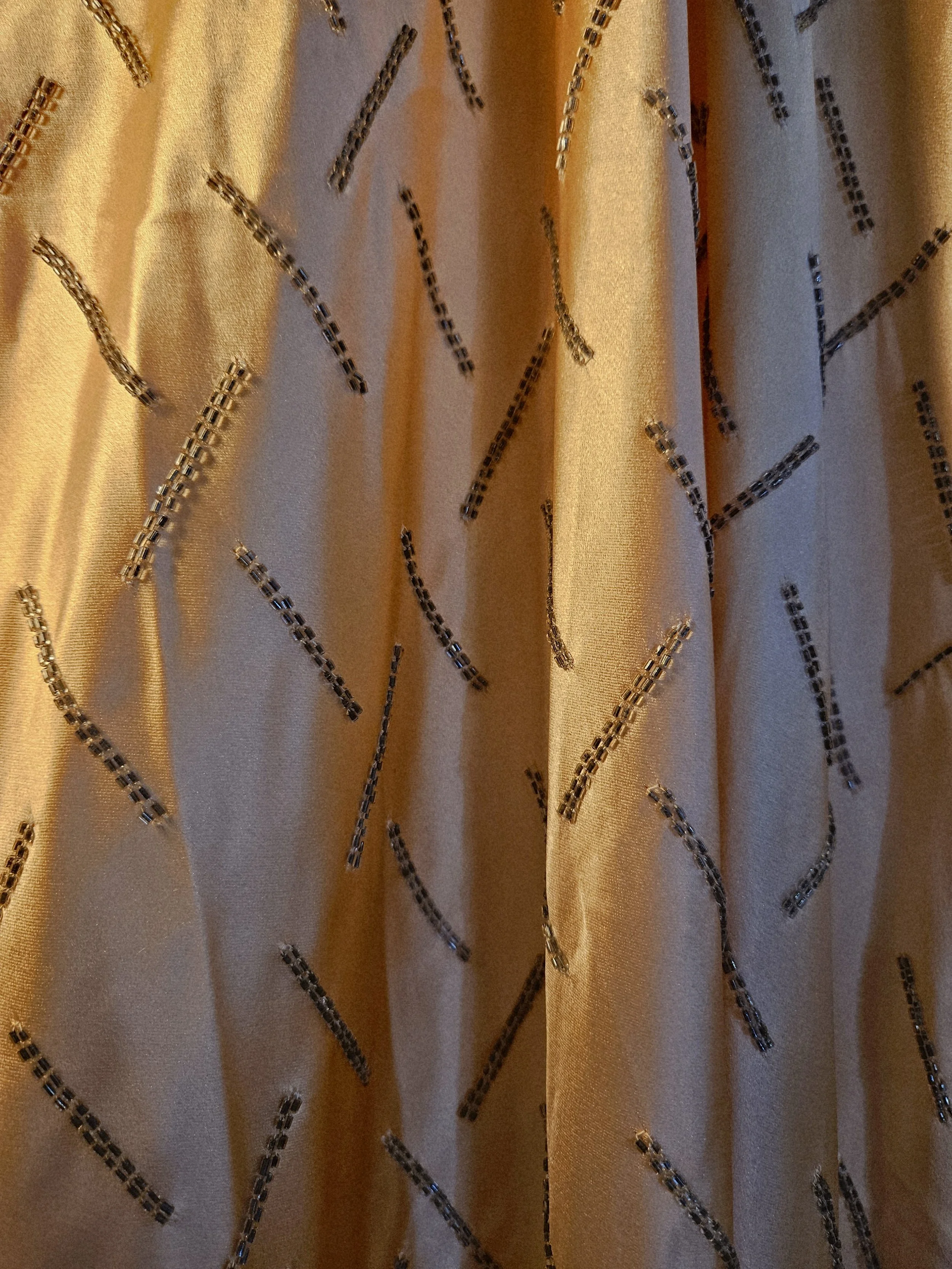
Step into timeless elegance with this exquisite authentic 1930s evening gown, a rare treasure from the golden age of Hollywood glamour. A luxurious peach silk satin, this dress is covered in antique lined bugle beads for a dramatic, glistening take on candlelit elegance. This romantic gown conjures Juliet on her balcony, mesmerizing her Romeo, with a flare for Medieval drama in its elegant clean lines that lengthen the body. This gown drapes effortlessly over the body, offering a statuesque silhouette that’s both refined and sensual. Meticulously adorned with hand-applied rhinestone accents throughout, it sparkles subtly in motion, capturing light from every angle. The neckline and back are framed with brilliant geometric rhinestone trim, adding a Deco flourish to an already unforgettable design.
This gown is a one-of-a-kind vintage piece, perfect for collectors, formal events, or anyone with a passion for true vintage luxury.
Features:
Authentic 1930s construction and materials
Bias-cut liquid satin for a fluid, body-skimming fit
All-over hand-applied rhinestone embellishments
Subtle train for dramatic movement
Original 1930s glass buttons at the wrists
The back of the gown features a V-plunge, with a beaded panel at its base.
The long train includes a loop so that the dress train can hang elegantly from a finger to keep the train off the ground as desired.
Garment Measurements:
Bust: 34 inches
Waist: 31 inches
Hips: 42 inches
Sleeve length: 24 inches
Dress length, front: 56 inches
Dress length, back: +23 inches
Fit: S/M
Notes:
This dress is cut on the bias, it means that the fabric drapes the body and the length will shorten based on how slim or curvier the body is.
Though some of the beading on this dress has been painstakingly restored, it has remained in remarkable excellent, nearly mint, vintage condition for almost 100 years and is a fantastic, special representation of the elegance of old Hollywood glamour.
History of 1930s Couture Quality Wedding Gowns:
1930s couture wedding gowns exude timeless elegance with bias-cut silk satin, body-skimming silhouettes, and Art Deco details like rhinestones, intricate lace, and dramatic trains. Often featuring cowl or detailed necklines, long sleeves, and open or decorated backs, these gowns embody vintage glamour and refined sophistication.